Skip to content

 What I’m Grateful For: Youngest Daughters
Last week, about thirty seconds after the Words e-blast went out, I hear a voice yelling from upstairs: “What?!? You’re grateful for ELDEST daughters?!? What about ME!?!”
This, in a nutshell, is what I”m grateful for when it comes to my youngest daughter. Only 17, she’s confident, go-getting,tough as nails. She’s also chock-full of sass and vinegar. Ready to jump on a horse, handle a working dog, or dig some fireline, she’s all the things I (nerdy, bookish, intellectual) have never been. And like my eldest daughter, she is also incredibly kind, caring and loves spending time with small children, kittens and the elderly. Honestly, I really don’t know how I possibly got these two amazing daughters, and as my mom has told me more than once, I haven’t done anything to deserve either of them (as you can guess, yes I indeed put my parents through some hell in my teenage years….)
PS – She demanded to proofread this before I was allowed to publish.
What I’m Reading:
My Name Was Eden by Eleanor Barker-White. This is a novel, and full disclosure, I always have a murder mystery or some kind of a novel handy in order to try to shut down my overactive brain. This one has an usually neat plot – based on the somewhat-scientific truth that twins sometimes vanish in the womb, either absorbed by the uterus or – more chillingly and the plot for this book – absorbed by their other twin. In this story, the author explores what might happen if a daughter who had absorbed her twin brother in the womb suddenly turned into that brother – new personality and all – and what a mother might do. Fun reading!
Tip from Gene:
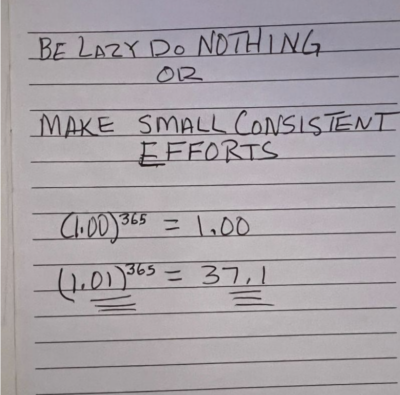
(1.00)^365 = 1.00
(1.01)^365 = 37.78
“`
This is a demonstration of the concept of compound interest or the exponential growth effect, sometimes related to the principle known as the “compound effect” or “1% better” concept. The principle states that if you improve by just 1% every day, then over the course of a year, these small changes will compound into significant growth.
The math here shows two scenarios:
1. If you don’t grow at all (0% improvement each day, hence (1.00)^365), you will be exactly where you started after a year (1.00 times your original self).
2. If you improve by 1% each day ((1.01)^365), you will be about 37.78 times better than when you started after a year, due to the compounding effect.
This principle can be applied to personal growth, financial investment, learning new skills, fitness, and virtually any aspect of life where consistent effort over time can lead to exponential improvements or results. It’s a very powerful concept when applied to habits and continuous improvement.
As for an example of how to use this formula: if you’re working on your business goals, like growing your monthly income, the formula suggests that by making consistent daily improvements in your strategies, skills, or services, you could potentially see a compounded positive effect on your income. For instance, if you improve your marketing strategies by 1% every day, the compounded effect could lead to significant growth in client acquisition and revenue over the course of a year.
What’s your choice?
Quote I’m Pondering:
Seen On the Mug that My Youngest Daughter Bought for Herself: “Best Person Ever.”